








Beyond Blair and Corbyn: Can Britain’s New Political Landscape Heal Labour’s Old Divide?
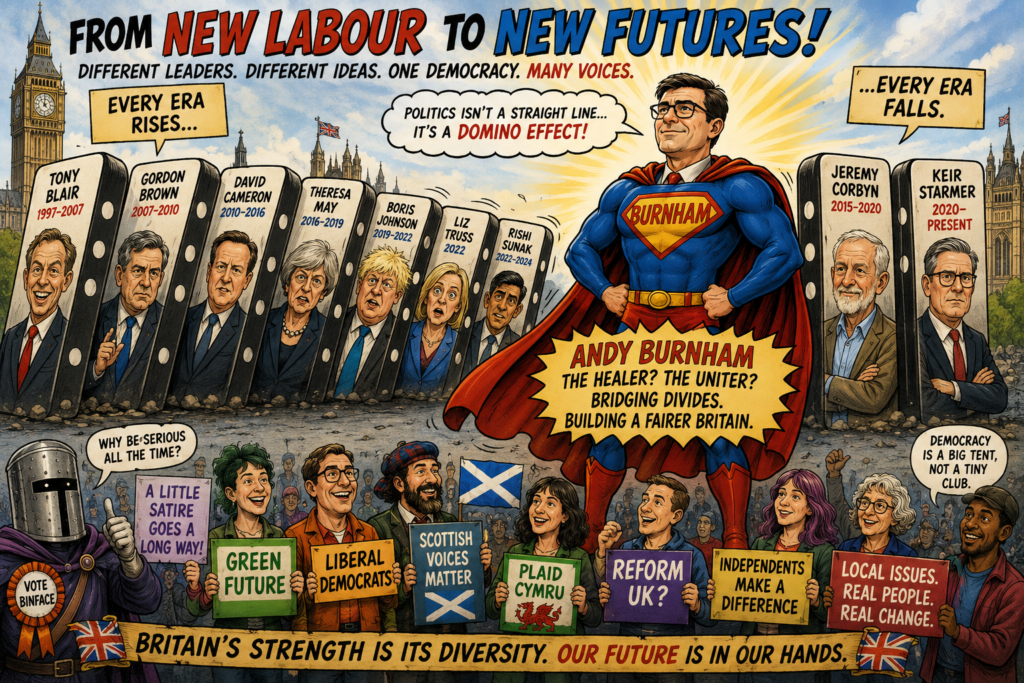
For more than a decade, British politics has been dominated by an argument that has often appeared impossible to resolve. On one side stands the legacy of New Labour, associated with Tony Blair, Peter Mandelson and, more recently, Keir Starmer. On the other stands the democratic socialist movement inspired by Jeremy Corbyn. The debate has frequently been framed as a choice between electability and idealism, pragmatism and principle, moderation and radicalism. Yet the political landscape that has emerged following the 2024 and subsequent electoral cycles suggests that this binary may no longer adequately describe British democracy. Instead, Britain appears to be entering a more pluralistic era in which political representation is becoming increasingly diverse. Ironically, it may be this fragmentation that ultimately strengthens rather than weakens British democracy.
Jeremy Corbyn inherited a Labour Party profoundly shaped by the Blair years. New Labour remains one of the most electorally successful periods in the party’s history, winning three consecutive general elections while introducing policies such as the National Minimum Wage, constitutional reform and significant investment in the NHS and education (Seldon, 2005). Yet its legacy has always been contested. The Iraq War, market-oriented public service reforms and close relationships with financial institutions left many traditional Labour supporters questioning whether the party had drifted too far from its democratic socialist roots (Driver and Martell, 2006).
Corbyn’s election as Labour leader in 2015 represented an extraordinary political upset. Few expected the veteran backbencher to defeat the parliamentary establishment, yet his campaign mobilised hundreds of thousands of members around policies including public ownership of railways and utilities, opposition to austerity, stronger trade union rights and increased public investment (Seymour, 2016). Whatever one’s opinion of Corbyn, his leadership fundamentally changed the national conversation. Policies once dismissed as politically impossible—including railway nationalisation, greater state intervention and industrial strategy—later became subjects of mainstream political debate.
Yet Corbyn’s leadership also exposed significant weaknesses. Labour remained deeply divided, Brexit fractured both the electorate and the parliamentary party, while allegations of antisemitism created a prolonged political crisis that damaged public confidence. Although Labour performed unexpectedly well in the 2017 General Election, the 2019 defeat was its worst since 1935 (Bale, 2023). Historians continue to debate whether this outcome reflected Corbyn’s leadership, Brexit, media hostility or a combination of all three factors.
Keir Starmer inherited a party traumatised by that defeat. His central argument was straightforward: Labour could only improve people’s lives if it first returned to government. Starmer therefore prioritised discipline, electoral credibility and institutional trust. The strategy succeeded electorally, returning Labour to office with a commanding parliamentary majority. Yet it also alienated many members who believed that the party had retreated from many of the transformative ambitions that had inspired Labour’s remarkable membership growth between 2015 and 2019.
Here lies one of modern British politics’ most striking ironies. During the Corbyn years, many leading figures associated with New Labour argued that experience, professionalism and moderation offered the safest route to competent government. Peter Mandelson remained one of the most influential representatives of that political tradition. Starmer’s decision to elevate Mandelson to one of Britain’s most senior diplomatic roles therefore symbolised continuity with Labour’s centrist past. However, the subsequent controversy surrounding Mandelson’s historical association with Jeffrey Epstein and the political fallout that followed created an unexpected reversal. Starmer later acknowledged that he would not have proceeded with the appointment had the full circumstances been known and accepted responsibility for the decision, despite maintaining that key information had not been disclosed during the appointment process (Al Jazeera, 2026). The episode did not invalidate New Labour’s achievements, but it did demonstrate that political judgement is not the exclusive preserve of any ideological tradition.
Equally, it would be simplistic to portray Jeremy Corbyn as either a misunderstood visionary or a failed leader. His leadership inspired unprecedented political participation and energised many younger voters, but it also struggled to maintain unity within Parliament and failed to convince enough of the wider electorate that Labour was ready to govern nationally (Bale, 2023). Likewise, Starmer’s electoral success should not be dismissed simply because sections of the Labour membership feel politically homeless. Both leaders achieved genuine successes while encountering genuine limitations.
Perhaps the more interesting development is what has happened outside the traditional Labour divide. Corbyn’s decision to establish a new political movement following his departure from Labour has demonstrated that there remains a significant appetite for democratic socialist politics beyond the structures of the modern Labour Party. While still developing organisationally, the movement has already shown that progressive politics in Britain no longer depends exclusively upon Labour itself. Rather than disappearing after his leadership ended, Corbyn’s political influence has evolved into a broader challenge to the traditional two-party assumptions that have shaped Westminster for decades.
At the opposite end of the political spectrum—but equally illustrative of democratic diversity—satirical movements such as Count Binface have become an increasingly familiar feature of British elections. Although few voters expect Count Binface to enter government, his campaigns perform an important democratic function. Through humour, satire and absurdity, they encourage political engagement while reminding established parties that no institution is immune from public scrutiny. Democracy is healthier when it can laugh at itself as well as govern itself.
Indeed, recent British elections have revealed an increasingly eclectic Parliament and electorate. The Liberal Democrats have re-established themselves across southern England. The Green Party has achieved record parliamentary representation. Reform UK has reshaped debates surrounding immigration and political trust. Plaid Cymru and the Scottish National Party continue to express distinct national identities within the Union. Independent MPs have emerged in constituencies where local issues outweighed traditional party loyalties. Corbyn’s own electoral success outside Labour illustrates that political legitimacy is no longer monopolised by the major parties. Rather than representing democratic decline, this diversity may instead signal democratic adaptation.
Political scientists have often argued that healthy democracies function as “broad churches” capable of accommodating competing philosophies within peaceful constitutional frameworks (Lijphart, 2012). Britain has traditionally relied upon broad coalition parties to absorb these differences internally. Increasingly, however, those differences appear to be expressing themselves across multiple parties rather than within just two dominant organisations. While this fragmentation undoubtedly creates new challenges for government formation and policy stability, it also allows a wider range of political identities to find democratic expression.
This broader perspective also reframes Labour’s internal disputes. For almost a decade, commentators have spoken of a struggle between the so-called “militant left” and “New Labour”. Yet these labels often obscure as much as they explain. Most Labour members, whether supportive of Corbyn or Starmer, share commitments to reducing inequality, strengthening public services and improving living standards. Their disagreements concern methods rather than ultimate objectives. The language of faction has frequently amplified differences while overlooking substantial areas of common ground.
It is within this context that Andy Burnham emerges as a particularly intriguing figure. Burnham possesses credibility among many supporters of New Labour while also retaining considerable respect from sections of Labour’s democratic socialist tradition. As Mayor of Greater Manchester he has combined pragmatic administration with visible advocacy for public transport reform, regional devolution and social justice. Unlike many national politicians, Burnham has generally resisted becoming a symbolic representative of either faction. His politics often appear rooted less in ideological branding than in practical municipal governance (Richards, 2021).
Whether Burnham could genuinely heal Labour’s long-standing internal divisions remains uncertain. Political schisms rarely disappear overnight. Nevertheless, he may represent one of the few senior figures capable of speaking to both traditions without immediately provoking hostility from either. If Labour is ever to reconcile its electoral pragmatists with its democratic socialists, it will likely require leaders prepared to acknowledge that both traditions contributed something valuable to the party’s history.
Ultimately, the most hopeful lesson emerging from contemporary British politics may extend beyond Labour altogether. Britain today possesses a political landscape far richer than the familiar narratives of left versus right or Blair versus Corbyn. Voters increasingly have meaningful choices across the political spectrum, from democratic socialism to liberalism, environmentalism, regional nationalism, conservatism, populism and even political satire. While commentators often describe this fragmentation as evidence of democratic crisis, it may equally be interpreted as evidence of democratic vitality. Citizens are finding new ways to express political identity rather than abandoning democracy itself.
The irony of recent years is therefore profound. Labour spent much of the previous decade consumed by arguments over its own identity, while British democracy quietly became more representative of a wider range of political voices than at almost any point in recent history. Corbyn’s continued electoral relevance outside Labour, the rise of smaller parties, the resilience of local politics, the enduring popularity of independent candidates and even the public affection for figures such as Count Binface all suggest that British democracy remains remarkably adaptable. Far from signalling constitutional decline, this growing plurality may represent one of the healthiest developments in British politics for a generation.
If there is a lesson to be drawn, it is not that Blairism defeated Corbynism or that Corbynism has somehow been vindicated. Rather, it is that democracy functions best when no single tradition assumes it possesses a monopoly on political wisdom. Britain’s political future is unlikely to belong exclusively to New Labour, democratic socialism or any single ideology. Instead, its greatest strength may continue to lie in being what it has often been at its best: a broad church in which competing visions coexist peacefully, challenge one another vigorously and ultimately leave the electorate—not political factions—to decide.
References
Al Jazeera (2026) UK PM Starmer admits mistaken call on Mandelson, rejects calls to resign. Available at: https://www.aljazeera.com/news/2026/4/20/uk-pm-starmer-admits-mistaken-call-on-mandelson-rejects-calls-to-resign (Accessed: 25 July 2026).
Bale, T. (2023) The Conservative Party After Brexit and Britain’s New Political Landscape. Cambridge: Polity.
Driver, S. and Martell, L. (2006) New Labour. 2nd edn. Cambridge: Polity.
Lijphart, A. (2012) Patterns of Democracy: Government Forms and Performance in Thirty-Six Countries. 2nd edn. New Haven: Yale University Press.
Richards, D. (2021) The Rise of Metro Mayors and English Devolution. Bristol: Policy Press.
Seldon, A. (2005) Blair. London: Free Press.
Seymour, R. (2016) Corbyn: The Strange Rebirth of Radical Politics. London: Verso.