






Brain Freezer: How Much of Your Brain Would Need to Survive for You to Live Forever?
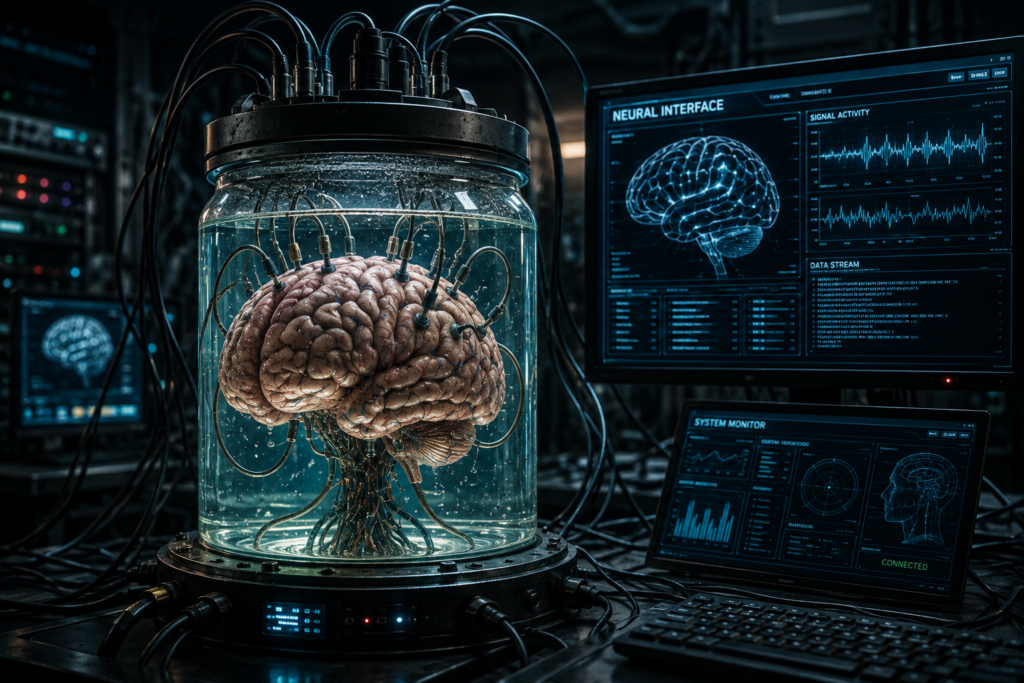
Death has always represented humanity’s greatest mystery. Religions have offered spiritual answers, philosophers have debated the nature of the soul, and scientists have sought biological explanations for consciousness itself. Today, however, advances in neuroscience and artificial intelligence invite an entirely new question. Rather than asking whether consciousness survives death, perhaps we should first ask something more fundamental: how much of the brain is actually needed for consciousness to continue?
This question sits at the intersection of neuroscience, philosophy and artificial intelligence. While today’s AI systems are becoming increasingly capable of mimicking human personalities through vast amounts of personal data, they almost certainly do not preserve the subjective experience of being that individual. An AI trained on every conversation, photograph, diary entry and decision I have ever made may become an astonishingly accurate version of “me,” but it would still remain a sophisticated imitation rather than my continuing consciousness.
That distinction is important.
A digital replica could comfort grieving relatives, preserve family history and even continue offering advice based upon decades of accumulated experience. Companies such as HereAfter AI and StoryFile already demonstrate early versions of this concept, allowing families to interact conversationally with digital representations of deceased loved ones. As large language models become increasingly sophisticated, these digital personalities may become almost indistinguishable from the people upon whom they were trained (Park et al., 2023). Yet even if the behaviour appears authentic, few neuroscientists would argue that the original conscious person continues to exist.
This naturally leads to a far more intriguing possibility.
What if the solution is not to replace the brain, but to preserve part of it?
For decades, neuroscience has searched for the location of consciousness. Surprisingly, no single “consciousness centre” has ever been discovered. Instead, modern theories increasingly describe consciousness as an emergent property arising from networks of interacting brain regions rather than one isolated structure (Dehaene, 2014; Tononi et al., 2016). Conscious experience appears to depend upon communication across multiple parts of the brain rather than any single collection of neurons.
This creates an extraordinary scientific question.
If consciousness depends upon networks rather than individual structures, how much of that network would actually need to survive?
Consider several possibilities.
Suppose only the visual cortex survived. A person might still process visual information, but would almost certainly lose memory, language, personality and decision-making. Conversely, preserving only the hippocampus would retain certain memory functions but eliminate many other aspects of conscious experience. The cerebellum, despite containing approximately 80% of the brain’s neurons, appears to contribute relatively little to conscious awareness, illustrating that neuron count alone does not determine consciousness (Sultan and Glickstein, 2007).
Perhaps consciousness is less like a light switch and more like a campfire. Remove one log and the fire continues burning. Remove too many, however, and eventually the flame disappears altogether. Neuroscience has not yet identified where that threshold lies.
This idea forms the scientific foundation of what I have begun thinking of as the Brain Freezer hypothesis.
Rather than preserving an entire body indefinitely, future medical technologies might instead preserve only the minimum biological neural network necessary to sustain conscious awareness. Artificial systems could potentially replace many supporting functions. Vision might be supplied through cameras. Hearing through microphones. Artificial intelligence could assist with language processing, memory retrieval and interaction with the external world. Robotic bodies might provide mobility. The preserved biological brain would remain the conscious core while technology supplied the senses and physical capabilities that ageing or disease had taken away.
This differs fundamentally from creating a digital copy.
A personality simulation begins with data and attempts to recreate behaviour. The Brain Freezer hypothesis begins with the original biological consciousness itself and asks how technology might support its continued existence. One approach produces a convincing facsimile; the other seeks continuity of subjective experience.
Of course, enormous scientific obstacles remain.
Current medicine cannot preserve living brain tissue indefinitely outside the body. We do not fully understand how memories are encoded, how consciousness emerges or precisely which neural circuits are indispensable. Brain-computer interfaces remain in their infancy, although remarkable progress has been made in recent years through projects restoring communication to paralysed patients and enabling robotic limbs to be controlled directly by neural activity (Willett et al., 2023).
Equally important are the philosophical questions.
If only part of a brain survives, is the resulting individual still the same person? At what point does gradual technological replacement become the creation of someone new? Philosophers such as Derek Parfit (1984) argued that personal identity may depend more upon psychological continuity than strict biological continuity. Others maintain that subjective consciousness requires uninterrupted biological existence. The debate remains unresolved.
Perhaps that uncertainty is precisely what makes the question so fascinating.
Science fiction has long imagined uploading minds into computers, but reality may prove rather more subtle. Instead of replacing biology entirely, the future may involve preserving just enough of it to maintain conscious continuity while allowing technology to assume supporting roles. The challenge would no longer be building an artificial mind from scratch but identifying the smallest biological foundation capable of sustaining the original one.
Whether such a future proves possible remains unknown. Yet history repeatedly reminds us that questions once dismissed as fantasy often become tomorrow’s engineering problems. Heart transplantation, artificial limbs controlled by thought and conversational artificial intelligence all seemed extraordinary only decades ago.
The real question, therefore, may not be whether humans can one day extend conscious existence beyond biological death. It may be far simpler—and far more profound:
How much of you must remain before you are still you?
References
Dehaene, S. (2014) Consciousness and the Brain: Deciphering How the Brain Codes Our Thoughts. New York: Viking.
Parfit, D. (1984) Reasons and Persons. Oxford: Oxford University Press.
Park, J.S. et al. (2023) ‘Generative Agents: Interactive Simulacra of Human Behavior’, Proceedings of the 36th ACM Symposium on User Interface Software and Technology, pp. 1–22.
Sultan, F. and Glickstein, M. (2007) ‘The cerebellum: Comparative and animal studies’, The Cerebellum, 6(3), pp. 168–176.
Tononi, G., Boly, M., Massimini, M. and Koch, C. (2016) ‘Integrated information theory: From consciousness to its physical substrate’, Nature Reviews Neuroscience, 17(7), pp. 450–461.
Willett, F.R. et al. (2023) ‘A high-performance speech neuroprosthesis’, Nature, 620, pp. 1031–1036.