




Could We Be Looking at Ourselves? The Strange Possibility Hidden Among the Galaxies
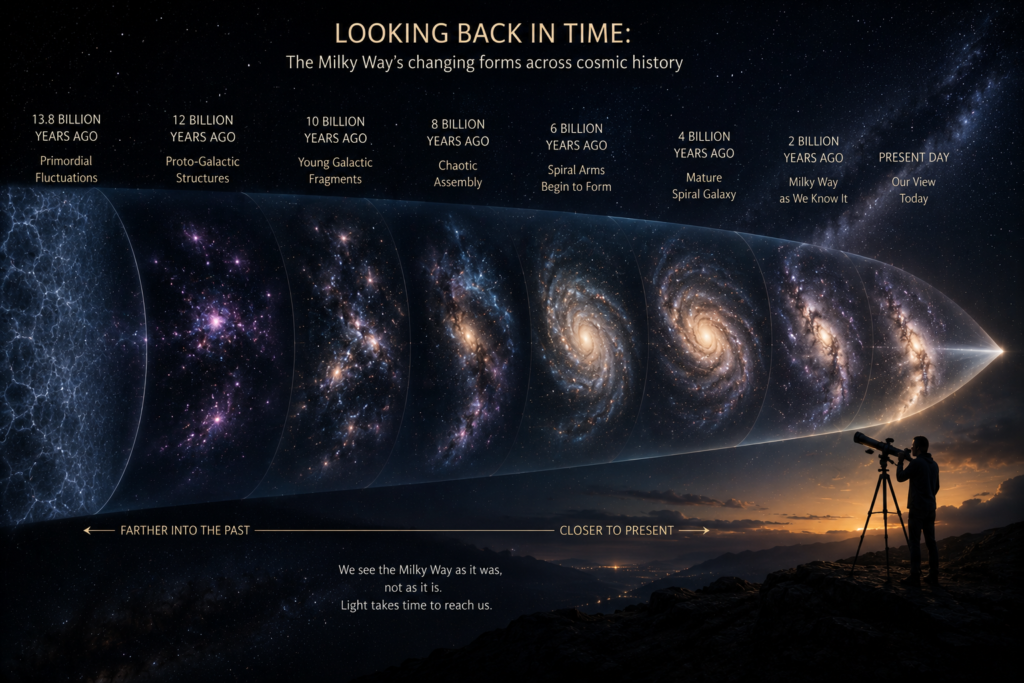
Every clear night, millions of people look into the sky believing they are looking outwards. It is one of the deepest assumptions we make about the Universe. Stars are over there. Galaxies are even further away. The further we look, the more distant the objects become. Astronomy seems wonderfully straightforward in that respect. Yet modern cosmology quietly undermines that intuition. Every telescope is not only looking across space—it is looking backwards through time.
When the James Webb Space Telescope photographs a galaxy more than thirteen billion light years away, it is not showing us a distant civilisation as it exists today. It is showing us a moment frozen shortly after the birth of the Universe. That galaxy has almost certainly changed beyond recognition since its light first began its journey. Some stars have exploded. Others have formed. Entire spiral arms may have appeared or disappeared. In truth, we have absolutely no idea what it looks like today because today has not yet reached us.
It is one of the most extraordinary limitations placed upon human knowledge. We can never observe the Universe as it is. We can only observe the Universe as it was.
Once you truly appreciate that fact, an unsettling question begins to emerge.
How do we know that every distant galaxy we observe is actually a different galaxy?
At first the suggestion sounds absurd. Surely every spiral galaxy is simply another island of stars scattered somewhere across the cosmos. Yet the more one thinks about it, the less obvious the answer becomes. What if the Universe itself is folded in ways we do not yet understand? What if light does not simply disappear into an infinite abyss, but eventually finds its way back home? Could it be possible that somewhere among the billions of galaxies catalogued by astronomers lies an ancient image of our own Milky Way?
Remarkably, this is not simply an idle philosophical exercise. Variations of this idea have appeared in serious cosmological research for decades. They emerge not because astronomers believe we have already found such an image, but because the mathematics of Einstein’s General Relativity leaves the overall shape of the Universe surprisingly unconstrained. Gravity tells space-time how to bend, but it does not tell the Universe how large it is, whether it loops back on itself or whether travelling far enough in one direction could eventually bring you back to where you started.
We encounter simple versions of this geometry more often than we realise. Imagine an ant walking across the surface of the Earth. To the ant, the ground appears perfectly flat. There are no edges and no clues that it is actually travelling around a sphere. Given enough time, however, the ant would eventually arrive back at its starting point without ever turning around. Now replace the ant with a photon of light. Replace the Earth with the Universe itself. Suddenly the impossible begins to look mathematically plausible.
If space possesses what cosmologists call a multiply connected topology, light could, in principle, complete an unimaginably long journey around the cosmos before returning to its point of origin. Instead of seeing another galaxy billions of light years away, we might one day find ourselves looking at the Milky Way as it existed billions of years ago. We would not be observing a reflection in the conventional sense, but rather a delayed image created by the architecture of space itself.
This possibility has been taken seriously enough that cosmologists have searched for evidence of it. In 1998, Neil Cornish, David Spergel and Glenn Starkman proposed looking for repeated patterns in the Cosmic Microwave Background—the faint radiation left behind by the Big Bang. If space wraps around itself, the same ancient light should arrive from different directions, producing what they called “matched circles” across the sky (Cornish, Spergel and Starkman, 1998). It was an elegant idea because it transformed an abstract philosophical question into something that could actually be tested.
So far, those circles have not been found. Data collected by both the Wilkinson Microwave Anisotropy Probe and the European Space Agency’s Planck mission suggest that, if the Universe does possess such a topology, it must either be vastly larger than the observable Universe or arranged in a geometry that hides these repeating signatures. For most cosmologists, this is sufficient reason to conclude that the galaxies we observe are almost certainly independent systems evolving according to the same physical laws rather than recycled images of ourselves.
Yet history urges a little humility. Astronomers once believed the Milky Way was the entire Universe. They once thought spiral nebulae were clouds of gas within our own galaxy. Edwin Hubble demonstrated otherwise, expanding the known Universe almost overnight. Scientific revolutions often begin with questions that initially sound unreasonable.
Perhaps the greatest value of ideas like this is not whether they ultimately prove correct. Their value lies in exposing the assumptions hidden beneath our understanding of reality. We instinctively imagine the Universe as an enormous empty container stretching endlessly in every direction because that picture feels intuitive. Nature has repeatedly demonstrated that intuition is a poor guide. The Earth is not stationary. Time is not absolute. Space bends. Black holes evaporate. Empty space itself expands.
Against that backdrop, the suggestion that the Universe might occasionally allow us to glimpse an earlier version of our own galaxy seems less like fantasy and more like another invitation to remain curious.
Whether we are looking at ancient echoes of the Milky Way or simply countless neighbouring galaxies may ultimately matter less than the perspective the question provides. Every point of light overhead is not merely distant; it is historical. The night sky is the largest archive ever discovered, preserving moments from throughout cosmic history. Somewhere among those billions of galaxies lies the story of how the Universe became what it is today. Whether one of those stories eventually turns out to be our own remains an open question—but it is exactly the kind of question that keeps astronomy one of humanity’s greatest adventures.
References
Cornish, N.J., Spergel, D.N. and Starkman, G.D. (1998) Measuring the Topology of the Universe. Proceedings of the National Academy of Sciences, 95(1), pp.82–84.
Einstein, A. (1916) The Foundation of the General Theory of Relativity. Annalen der Physik, 49, pp.769–822.
Luminet, J.P., Weeks, J., Riazuelo, A., Lehoucq, R. and Uzan, J.P. (2003) Dodecahedral Space Topology as an Explanation for Weak Wide-Angle Temperature Correlations in the Cosmic Microwave Background. Nature, 425(6958), pp.593–595.
Planck Collaboration (2020) Planck 2018 Results. VI. Cosmological Parameters. Astronomy & Astrophysics, 641, A6.
Weinberg, S. (2008) Cosmology. Oxford: Oxford University Press.