








The Desertification of the Oceans: How Bottom Trawling is Turning Living Seabeds into Underwater Deserts
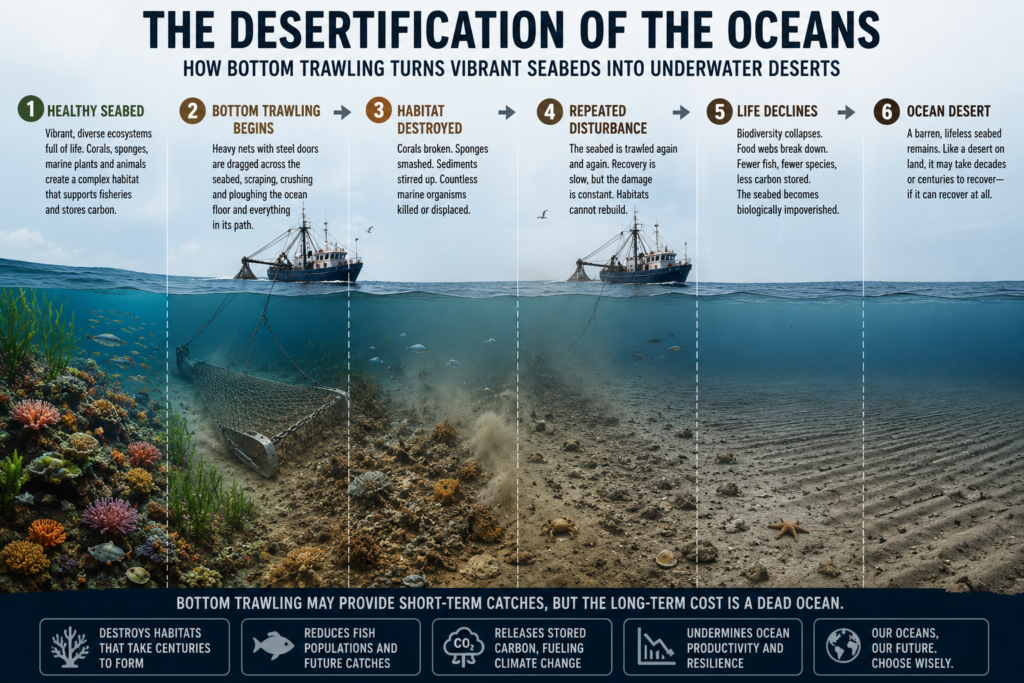
When most people hear the word desertification, they picture expanding sands swallowing fertile farmland. Rarely do they imagine the same process occurring beneath the waves. Yet across vast areas of the world’s continental shelves, marine scientists have documented an ecological transformation that is remarkably similar. Rich, structurally complex ecosystems that took centuries to develop are being flattened, simplified and stripped of biodiversity through one of the most destructive fishing methods ever devised: bottom trawling.
The oceans cover more than 70% of the Earth’s surface and contain ecosystems every bit as intricate as tropical rainforests. Coral gardens, sponge fields, shell beds, seagrass meadows and deep-sea reefs provide shelter, breeding grounds and feeding habitats for thousands of marine species (FAO, 2022). These underwater landscapes are not simply collections of fish; they are living architecture. Just as forests rely upon trees to create habitats, the seabed depends upon corals, sponges, worms, shellfish and marine plants to create a three-dimensional environment capable of sustaining complex food webs.
Bottom trawling fundamentally alters this architecture. Large fishing vessels tow enormous weighted nets across the seabed using steel doors, chains, rollers and heavy ground gear designed to maximise contact with the ocean floor. As the gear moves forward it scrapes, crushes and ploughs through everything in its path, disturbing sediments and removing both target fish and countless non-target organisms (Kaiser et al., 2006). Unlike pelagic fishing, which targets species swimming in open water, bottom trawling deliberately exploits habitats where marine life is concentrated. The very places that make excellent fishing grounds are often those most vulnerable to physical destruction.
The comparison with agricultural desertification is striking. Healthy soils contain diverse microorganisms, insects, fungi and plant roots that support productivity. Remove that complexity and the land gradually loses fertility. A similar process occurs beneath the sea. Repeated trawling destroys slow-growing organisms that provide habitat for juvenile fish and invertebrates. Coral structures that required centuries to form may be shattered within minutes. Sponge gardens that filter enormous volumes of seawater disappear, while shell beds that stabilise sediments become fragmented or entirely removed (Norse et al., 2012).
The result is a progressively flatter and less diverse seabed. Instead of complex underwater landscapes supporting hundreds of interacting species, the ocean floor increasingly resembles a biological monoculture. The physical habitat becomes homogenised, biodiversity declines, and ecological resilience is reduced. Marine scientists frequently describe heavily trawled areas as exhibiting simplified benthic communities with diminished ecosystem function (Collie et al., 2000). In ecological terms, these regions begin to resemble underwater deserts.
The damage extends well beyond visible organisms. Every pass of a trawl stirs enormous clouds of sediment into the water column. These sediment plumes can smother nearby habitats, reduce light penetration and interfere with filter-feeding organisms. Recent research suggests that bottom trawling may resuspend significant quantities of organic carbon stored within marine sediments, accelerating its conversion into carbon dioxide and potentially contributing to climate change (Sala et al., 2021). Although estimates remain debated, the possibility that bottom trawling influences the global carbon cycle has transformed what was once viewed purely as a fisheries issue into a climate issue.
Perhaps the greatest tragedy lies in the differing timescales of destruction and recovery. A single trawling event may destroy habitats that require decades—or even centuries—to recover fully. Cold-water coral reefs, unlike their tropical counterparts, grow extremely slowly. Species such as Lophelia pertusa may add only millimetres each year, meaning that reefs damaged today could require generations to regain their former structure (Roberts et al., 2009). Some deep-sea sponge communities may recover even more slowly, if at all, under continued fishing pressure.
Supporters of bottom trawling rightly point out that it provides livelihoods for many fishing communities and contributes significantly to global seafood production. Demersal fisheries support thousands of jobs and form an important part of food security in numerous coastal nations (FAO, 2022). Simply banning bottom trawling without considering social and economic consequences would therefore be unrealistic and potentially harmful to communities that have depended upon fishing for generations.
The debate is therefore not between fishing and conservation, but between different methods of harvesting marine resources. Increasingly, fisheries scientists argue that long-term productivity depends upon maintaining healthy habitats rather than maximising short-term extraction (Hilborn et al., 2020). If nursery grounds are repeatedly destroyed, future fish populations inevitably decline regardless of annual catch limits. In this sense, habitat conservation and sustainable fisheries are not opposing objectives but mutually dependent ones.
Fortunately, evidence also demonstrates that recovery is possible. Marine Protected Areas (MPAs), particularly those excluding bottom-contact fishing gear, often show substantial improvements in biodiversity, habitat complexity and fish abundance over time (Edgar et al., 2014). Studies from protected reefs have documented increases in both species richness and the size of commercially valuable fish populations. Rather than reducing fisheries indefinitely, protected areas can act as breeding reservoirs whose populations eventually spill over into surrounding fishing grounds.
Technological innovation offers additional hope. Advances in selective fishing gear, improved seabed mapping, artificial intelligence-assisted navigation and precision fisheries enable vessels to target fish more accurately while avoiding particularly vulnerable habitats. Better satellite monitoring and electronic vessel tracking have also strengthened enforcement against illegal fishing in many regions.
Consumers likewise possess considerable influence. Certification schemes promoting sustainably harvested seafood encourage retailers and fisheries to adopt less destructive practices. Although certification systems are not without criticism, they demonstrate that market incentives can encourage environmental improvements alongside regulatory reform.
There is also growing recognition that the ocean floor performs functions extending far beyond fisheries. Healthy seabeds store carbon, recycle nutrients, filter water, support biodiversity and contribute to climate regulation. These ecosystem services possess enormous economic value, even though they rarely appear within conventional measures of national wealth (Barbier et al., 2011). Destroying them may therefore impose costs far exceeding the immediate value of the fish landed.
The metaphor of desertification captures an important ecological truth. Just as forests can be transformed into barren landscapes through repeated disturbance, living seabeds can be converted into simplified, biologically impoverished environments through continual trawling. The process is often invisible to those on land because it occurs hundreds of metres beneath the waves, yet its consequences extend throughout marine ecosystems and ultimately affect fisheries, biodiversity and climate itself.
The oceans have demonstrated remarkable resilience throughout Earth’s history, surviving asteroid impacts, ice ages and dramatic climatic shifts. However, resilience is not infinite. Modern industrial fishing has reached a scale unprecedented in human history, allowing vessels to reach virtually every continental shelf and many deep-sea ecosystems. Whether future generations inherit thriving underwater forests or increasingly barren marine deserts will depend largely upon decisions made during the coming decades.
Protecting the seabed is not simply about saving obscure marine organisms. It is about preserving the living foundation upon which the productivity of the oceans ultimately depends. If we continue to scrape away that foundation faster than nature can rebuild it, we risk discovering that deserts are not confined to dry land—they can also exist beneath the sea.
References
Barbier, E.B. et al. (2011) ‘The value of estuarine and coastal ecosystem services’, Ecological Monographs, 81(2), pp. 169–193.
Collie, J.S., Hall, S.J., Kaiser, M.J. and Poiner, I.R. (2000) ‘A quantitative analysis of fishing impacts on shelf-sea benthos’, Journal of Animal Ecology, 69(5), pp. 785–798.
Edgar, G.J. et al. (2014) ‘Global conservation outcomes depend on marine protected areas with five key features’, Nature, 506(7487), pp. 216–220.
FAO (2022) The State of World Fisheries and Aquaculture 2022. Rome: Food and Agriculture Organization of the United Nations.
Hilborn, R. et al. (2020) ‘Effective fisheries management instrumental in improving fish stock status’, Proceedings of the National Academy of Sciences, 117(4), pp. 2218–2224.
Kaiser, M.J. et al. (2006) Marine Ecology: Processes, Systems, and Impacts. Oxford: Oxford University Press.
Norse, E.A. et al. (2012) ‘Sustainability of deep-sea fisheries’, Marine Policy, 36(2), pp. 307–320.
Roberts, J.M., Wheeler, A.J. and Freiwald, A. (2009) Cold-Water Corals: The Biology and Geology of Deep-Sea Coral Habitats. Cambridge: Cambridge University Press.
Sala, E. et al. (2021) ‘Protecting the global ocean for biodiversity, food and climate’, Nature, 592(7854), pp. 397–402.